

TW DATA STORY
“TW is a role model about how to run a successful and respected community service.”
Tiraapendi Wodli Networked Way of Working (%)
Tiraapendi Wodli 20 Steps: Post Release Support Services (%)
“TW is accessible and respected by Community. From my experience, I could see that Community genuinely value TW and utilise the Hub as a place for connection and safe conversations.”

TIRAAPENDI WODLI HUB, 36 DALE ST, PORT ADELAIDE
“Other places tend to just ‘Aboriginalise’ a mainstream paradigm, and it falls over. But this one really is ground-up and community-driven and community-run.”
The Hub is a busy place!
On average, the Hub receives approximately 195 individuals and more than 440 presentations per month.
The Hub is open five days a week and operates without intake forms or referral requirements.
People can walk in without an appointment. Each month, more than 440 instances of support are provided,
and more than 650 people are supported across a year (Tiraapendi Wodli 2025a).
We provide support for community members and families with multiple and complex needs through a Justice Reinvestment lens.
The work that happens at the Hub spans practical help with housing, identification documents, food and clothing,
post-prison release support, family support, child protection matters, men’s and women’s gatherings, cultural connection,
and the everyday work of walking with people through whatever they are dealing with.
DATA Snapshot: Priority areas of support provided to community during 2025-26

49% Financial wellbeing
& food security
Access to one-off financial assistance including emergency food provisions and support to understand basic financial literacy, banking, bills, concessions

40% Housing stability
Assistance to navigate homelessness and public and community housing systems (including the homelessness gateway service) and support to maintain tenancy security

35% Active service referrals
’Walking alongside’ community members to navigate access to govt, non-govt, ACCO and other community-based services in priority areas of need including health, housing, mental health, drug and alcohol, rehabilitation, financial literacy and family support services

27% Access to ID
ID documents may include birth certificate, proof of age, drivers license, health records, Medicare documentation, banking records

25% Post-prison release support
The TW 20 Steps service provides targeted support to men and women in the first few months following release from prison to support navigation to essential services (such as housing, health, social and cultural support, social security, ID, banking, and employment services) to ensure successful return to community

23% Mental health & wellbeing
Holistic assistance for people with ongoing mental health and trauma issues including access to health, mental health, psychology and other wellbeing services to maintain stability living in the community

20% Family stability
The TW Aboriginal Families Thrive Program provides coordinated support to families including young people and children to improve family and household stability during challenging times, to establish positive family relationships, engage with family support services including advocacy support as needed, participate in children’s education and connect with community and culture
“[TW] takes a place-based approach that’s specific to Port Adelaide, but it does link it into that bigger systems approach, which supports the work on the ground. ”
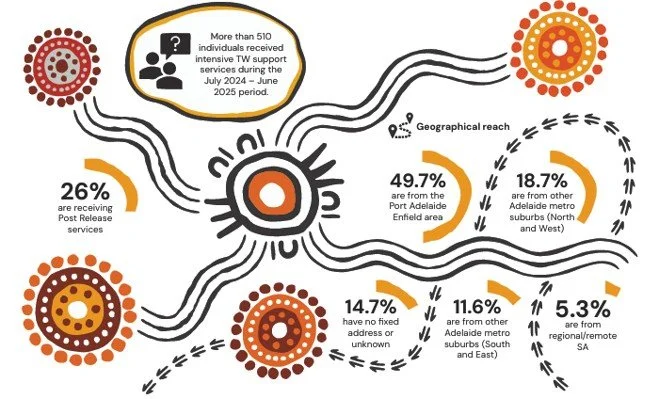
Data snapshot of visitors to Tiraapendi Wodli receiving support services 2024-25. Artwork by Alicia Papertalk, reproduced with permission, © Alicia Papertalk, 2025
Community who visit Tiraapendi Wodli
During 2024-25, most people coming through the Hub’s doors for support services were local, with one-half living in the Port Adelaide Enfield LGA area. A further one in five came from across Adelaide’s northern and western suburbs. Others came from regional and remote South Australia, and a significant group had no fixed address.
“People feel safe to engage without fear of racism and discrimination. That sort of stuff. The service is tailored to Aboriginal ways of knowing, being and doing. Holistic, flexible and person-centred support.”